A Compensation Scheme Shouldn’t Create a Second Full-Time Job
For many infected blood families, claiming compensation means far more than completing a form. It can involve finding decades-old records, dealing with probate, gathering evidence, reading complex guidance and repeatedly chasing answers. The scheme is supposed to deliver recognition and redress — not create another exhausting workload for people already carrying the consequences of the scandal.
By Anonymous · Oct 1, 2026
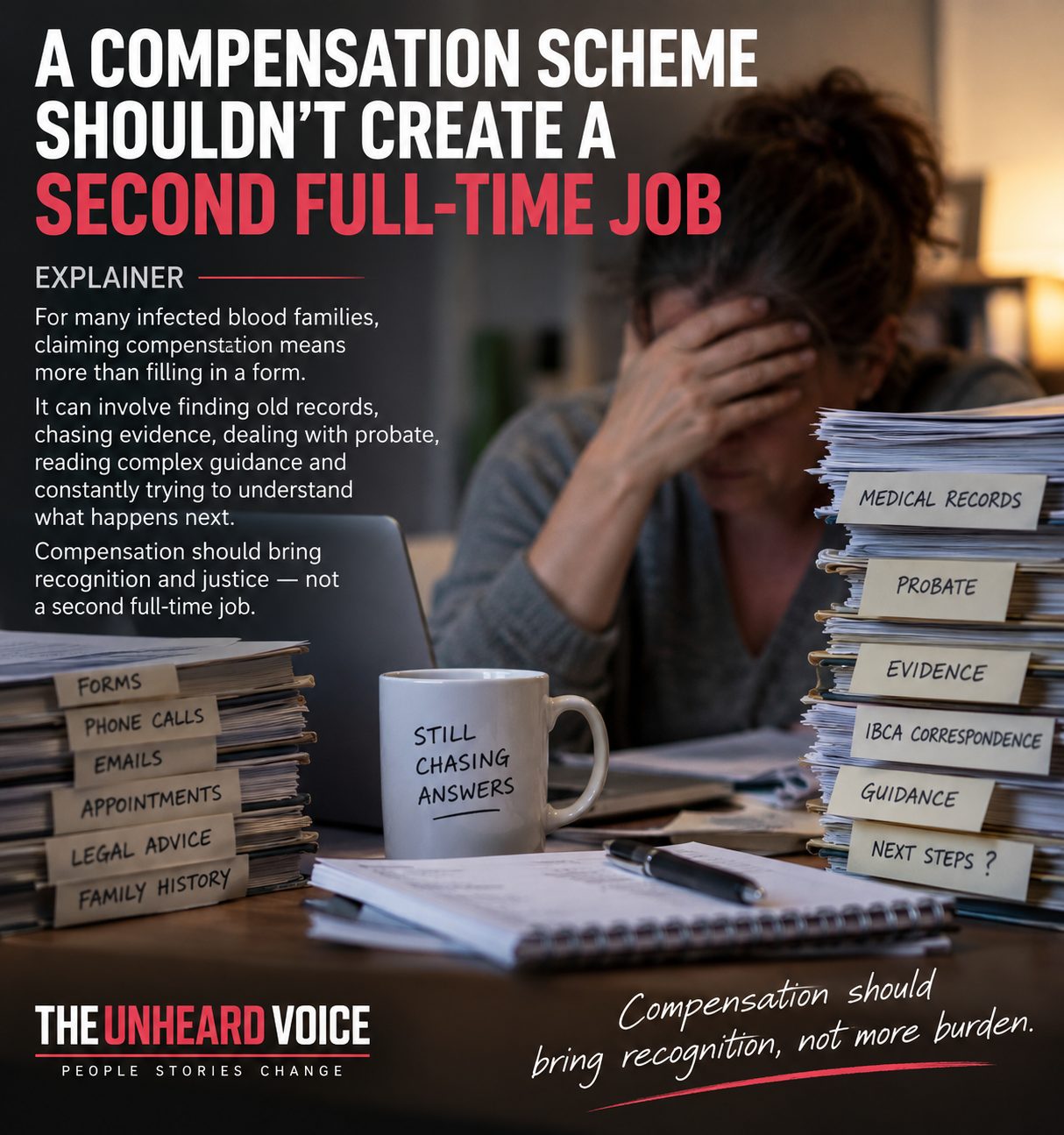
“Compensation is supposed to provide recognition and redress. The process of obtaining it should not become another burden families have to survive.”
For many people affected by the infected blood scandal, claiming compensation is not simply a matter of filling in a form and waiting for a decision.
It can mean finding decades-old medical records, tracking down evidence, applying for probate, speaking to solicitors, reading regulations, checking calculations, chasing correspondence, searching old paperwork, explaining family relationships and repeatedly trying to understand what happens next.
For people who are already ill, bereaved, caring for somebody else or living with the consequences of what happened to their family, that workload can become enormous.
A compensation scheme should not feel like a second full-time job.
IBCA does provide claim managers, and approved solicitors can offer independent legal support funded through the compensation process. That support is important.
But legal representation does not remove the wider burden from the claimant.
There are still emails to read, decisions to understand, documents to find and deeply personal histories to revisit.
For some families representing somebody who has died, there is another layer: probate.
That can mean locating certificates, proving family relationships, applying for legal authority to deal with an estate and working through paperwork before the compensation claim itself can properly move forward.
For some, the practical burden becomes almost as consuming as the claim.
There is administration.
There is time.
And there is emotional labour.
Imagine having to reconstruct the final years of somebody you loved decades after their death.
Imagine searching through boxes for old letters, hospital documents or financial records.
Imagine repeatedly explaining an infection, deterioration or death that shaped your family.
Then imagine doing all of that while trying to work, care for children, manage your own health or support somebody else.
That work does not appear on a compensation calculation.
But it is still work.
The infected blood compensation process is unusually complex because the scandal itself stretches across generations.
Some claims relate to treatment from decades ago.
Some involve deceased people.
Others involve several affected relatives, historical support schemes, missing records, complicated estates or evidence that has to be pieced together from different sources.
That complexity makes proper support even more important.
The challenge is not simply to create a legally correct compensation scheme.
It is to create one that ordinary people can actually navigate without becoming experts in compensation regulations, probate, medical evidence and administration simply because tragedy happened to their family.
Nobody should need their own filing system, legal vocabulary and unofficial project-management role just to understand where their claim stands.
Families should not have to spend hours comparing experiences with other claimants simply to work out what might happen next.
Community knowledge can be incredibly valuable.
People helping one another has been one of the strongest features of the infected blood community for decades.
But community members should not have to fill gaps that an official compensation system should be designed to fill itself.
Clear guidance matters.
Consistent information matters.
Realistic expectations matter.
Accessible professional support matters.
And so does recognising that every additional form, telephone call, request for evidence or unexplained delay lands on somebody who has already lived through the consequences of this scandal.
The success of the compensation scheme cannot therefore be measured only by how many claims are processed or how much money is paid.
The experience of getting there matters too.
Compensation is supposed to provide recognition and redress.
The process of obtaining it should not become another burden families have to survive.