Same need for warmth—different access to winter support
An anonymous reader asks why recognition through IBCA does not automatically bring entitlement to the annual infected blood winter fuel payment. We examine who qualifies and how heating needs are recognised for those outside the earlier support schemes.
By Anonymous · Oct 21, 2026
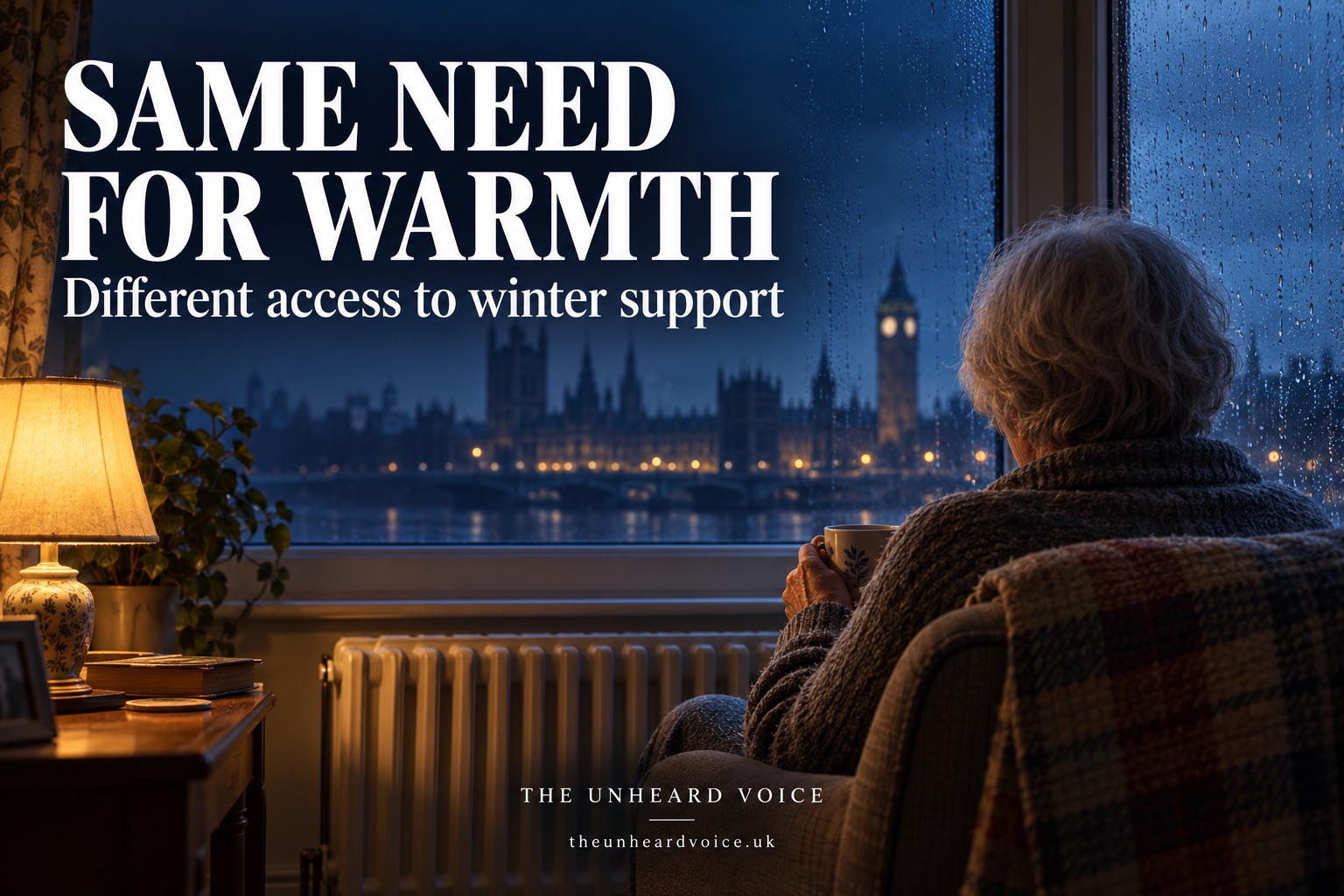
“When people face the same need to keep warm, how does the scheme ensure fair provision for those outside its earlier support arrangements?”
The need to keep a home warm does not depend on when someone’s infection was officially recognised.
An anonymous submission to The Unheard Voice raises a question about the infected blood compensation system: why can eligible beneficiaries retain an annual winter fuel payment through their continuing support, while recognition through IBCA does not automatically bring the same entitlement?
The reader, whose parent was infected, writes:
“Infected sick people and elderly widows could do with this winter fuel payment - why should some get it and not others?”
Their submission welcomes the protection given to existing beneficiaries. It asks what equivalent provision exists for people outside the earlier support schemes.
What is the winter payment?
The earlier infected blood support schemes provide a specific winter fuel payment to eligible beneficiaries.
Published England payment information lists £670 for 2025/26. Wales’s published rate for 2026/27 is £695. These figures must therefore be identified by scheme and year, rather than presented as one unchanged current rate. (nhsbsa.nhs.uk, wibss.wales.nhs.uk)
This payment is separate from the general pensioner Winter Fuel Payment. The issue here is heating support attached to infected blood support-scheme eligibility.
Government compensation examples include the winter fuel component within continuing annual support and explain that support payments increase annually in line with the Consumer Prices Index. (gov.uk)
Who can continue receiving support?
Government guidance says infected people registered with an Infected Blood Support Scheme before 1 April 2025 can choose to continue receiving support payments for life.
Those payments form part of the compensation arrangements. Continuing support is taken into account when calculating relevant compensation; it is not simply added to an otherwise identical full compensation package. (gov.uk)
IBCA describes an “adjusted” route involving continuing support alongside an adjusted compensation payment. Under the “core” route, someone previously receiving support instead stops those ongoing payments. (ibca.org.uk)
That distinction matters. Comparing the winter payment alone cannot establish which person receives more overall.
Bereaved partners have different rules
There are important exceptions to any suggestion that only people registered before April 2025 can receive continuing support.
Government guidance says bereaved partners registered before 1 April 2025 can choose continuing support. It also allows certain partners whose infected partner died after that date, before receiving compensation from IBCA, to register and choose ongoing support. (gov.uk)
IBCA says the support schemes closed to new infected applicants at the end of March 2025, while applications from bereaved partners close on 30 October 2026. The two groups do not have identical registration rules. (ibca.org.uk)
The government’s own examples show the distinction
The government’s published bereaved-partner guidance illustrates how compensation eligibility and support-scheme eligibility can differ.
One fictional example describes a bereaved partner receiving continuing support that includes a winter fuel payment.
Another describes a partner bereaved through hepatitis B who qualifies for compensation but does not qualify for support through an existing infected blood support scheme. These are illustrative government scenarios, not accounts of identifiable claimants. (gov.uk)
The distinction is therefore documented: recognition under the compensation scheme does not automatically create entitlement to the separate support-scheme payment.
Where are heating needs recognised?
The government describes compensation as addressing harm, financial loss and care needs. Different payment routes must therefore be considered as complete packages. (gov.uk)
However, the published material examined for this article does not establish that someone outside the continuing support route receives an equivalent, separately identified annual heating allowance.
That leaves a reasonable question about how those needs are recognised.
If additional heating costs are covered elsewhere in compensation, claimants should be able to understand where they are included, how they were valued and how that provision compares with continuing winter support.
The questions for ministers are straightforward:
* Where are additional winter heating costs recognised for eligible people outside the earlier support schemes? * Has the government assessed whether that provision is equivalent to the distinct annual winter payment? * Why should earlier support-scheme eligibility determine access to that particular form of help?
These are questions about the design of the scheme. The government sets the compensation framework; IBCA administers it.
A question of fair provision
Existing beneficiaries deserve security in the support they receive. People recognised through IBCA also deserve a clear account of what their compensation provides.
The absence of a separate winter payment does not, by itself, prove that someone receives less compensation overall. But it does justify scrutiny of how comparable needs are addressed across different routes.
The reader’s question remains: when people face the same need to keep warm, how does the scheme ensure fair provision for those outside its earlier support arrangements?