When Compensation Comes Too Late to Repair What Was Lost
Compensation can recognise financial loss, care and suffering — but some consequences cannot be restored years later: careers abandoned, relationships changed, homes lost, pensions reduced and decades spent surviving rather than living. It gives us a strong human piece without repeating the recent articles, and it gives us loads of visual material for the reel too.
By Anonymous · Oct 8, 2026
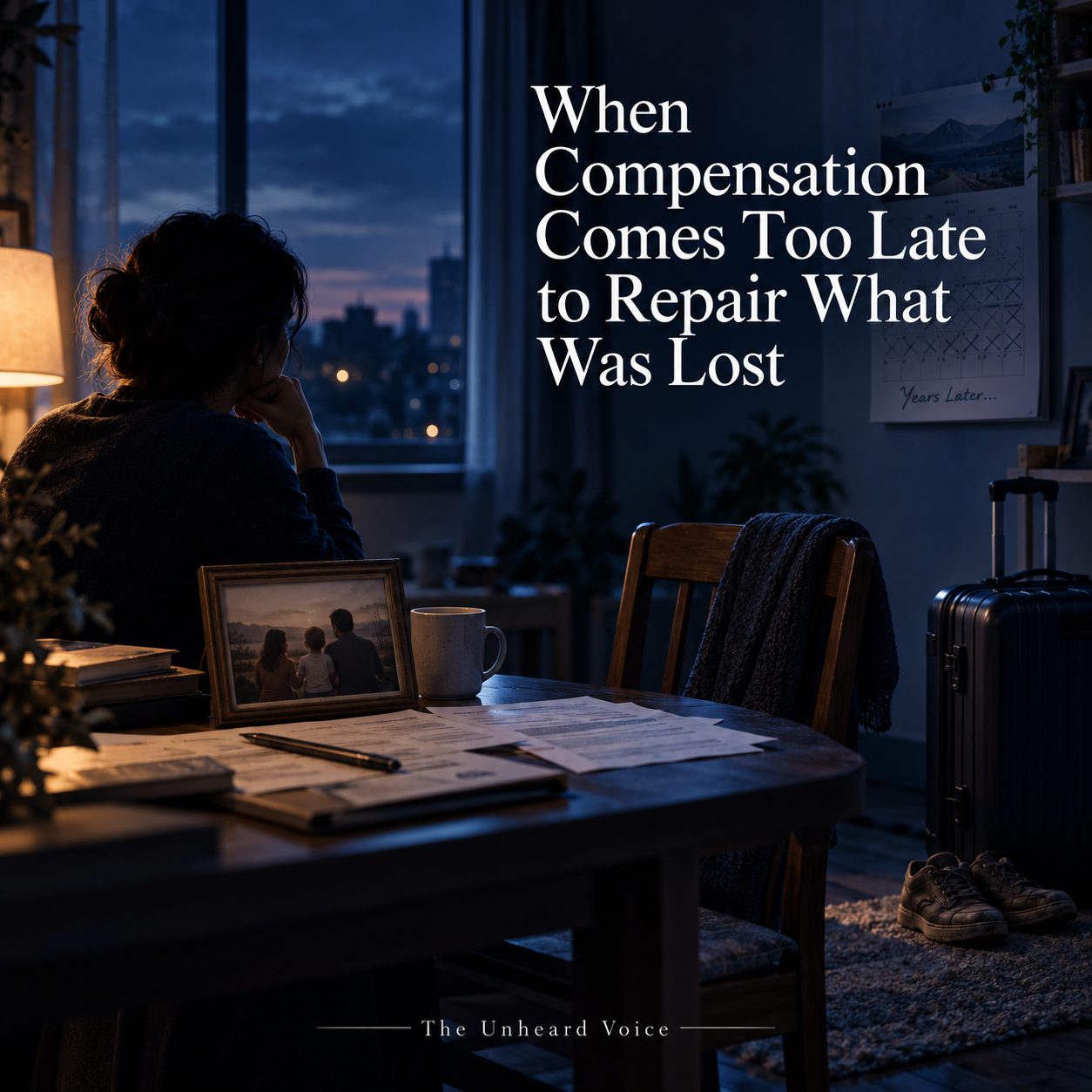
“Compensation can recognise what was lost. It can provide security. But it cannot return the years, careers, relationships or futures that were changed forever.”
Compensation matters.
For many people affected by the infected blood scandal, it represents recognition, financial security and an acknowledgement that devastating harm was done.
But there is another truth that sits alongside that.
Some losses cannot be repaired simply because money eventually arrives.
By the time compensation is paid, years may already have passed. Careers may have been abandoned. Pensions may have been reduced. Relationships may have changed under the strain of illness, caring and uncertainty. Families may have spent decades organising their lives around hospital appointments, declining health, fear and financial pressure.
That does not make compensation meaningless.
It means we should be careful not to confuse compensation with restoration.
A payment can recognise loss. It can provide security. It can ease pressure. It can help people make choices that were previously out of reach.
But it cannot give someone their twenties back.
It cannot return the years a parent spent caring instead of working.
It cannot recreate a career that never had the chance to develop.
It cannot undo the decisions families made because they were frightened about what tomorrow might bring.
And it cannot restore time with someone who has died.
For some families, the damage was gradual.
One person became ill, then another person reduced their hours to care for them. Savings were used. Holidays stopped. Social lives became smaller. Plans were postponed.
What looked from the outside like a series of individual decisions was often one long process of adaptation.
Families did what they had to do.
That is why the timing of compensation matters as much as the existence of compensation itself.
When financial recognition comes decades after the damage began, the person receiving it may already have lived most of the consequences.
They may be older.
They may be sicker.
They may have lost employment, relationships, confidence or independence.
A partner may have spent years providing unpaid care.
Children may have grown up in households shaped by illness, secrecy, stigma or bereavement.
None of those experiences disappear when a claim reaches completion.
There is also a wider question about what justice is supposed to achieve.
Compensation schemes are necessarily built around categories, tariffs, evidence and calculations. They have to convert deeply personal experiences into figures that can be administered consistently.
But human lives do not fit neatly into spreadsheets.
Two people may receive similar financial recognition while having lived completely different realities.
One may have remained in work.
Another may have lost a career.
One family may have had strong support.
Another may have carried everything alone.
One person may live long enough to benefit from an award.
Another may die before the process is complete.
That is why people speaking about compensation are often talking about much more than money.
They are talking about the life that might have been.
The home they might have owned.
The pension they might have built.
The career they might have pursued.
The relationship that might have survived.
The childhood that might have felt different.
The years that might have contained more freedom and less fear.
No compensation scheme can recreate those lives.
That does not mean the scheme should not try to recognise them fairly.
In fact, it makes fairness, speed, transparency and consistency even more important.
People should not have to spend more years fighting to explain losses they have already spent decades living with.
They should not have to feel that the passage of time has somehow made those losses less real.
And they should not be expected to treat compensation as though it closes the emotional history of what happened.
For some people, receiving compensation may bring relief.
For others, it may bring complicated emotions.
It may mark the end of one battle while creating space to think about everything that battle had previously kept at a distance.
That deserves understanding too.
The infected blood scandal did not simply cause medical harm.
It altered families, finances, careers, relationships and futures.
Compensation can recognise some of that.
It can provide something meaningful now.
But it cannot rewind the clock.
And any serious conversation about justice has to be honest about that.