When Did Grief Get an Age Limit?
A scandal that stole lives, childhoods, careers and futures. Yet families affected by infected blood still face compensation rules based on age, dependency and inheritance laws. As other national redress schemes allow individual assessments of psychological harm, The Unheard Voice asks why lifelong trauma, lost opportunities and the sacrifices of bereaved families are not more fully recognised.
By Anonymous · Oct 19, 2026
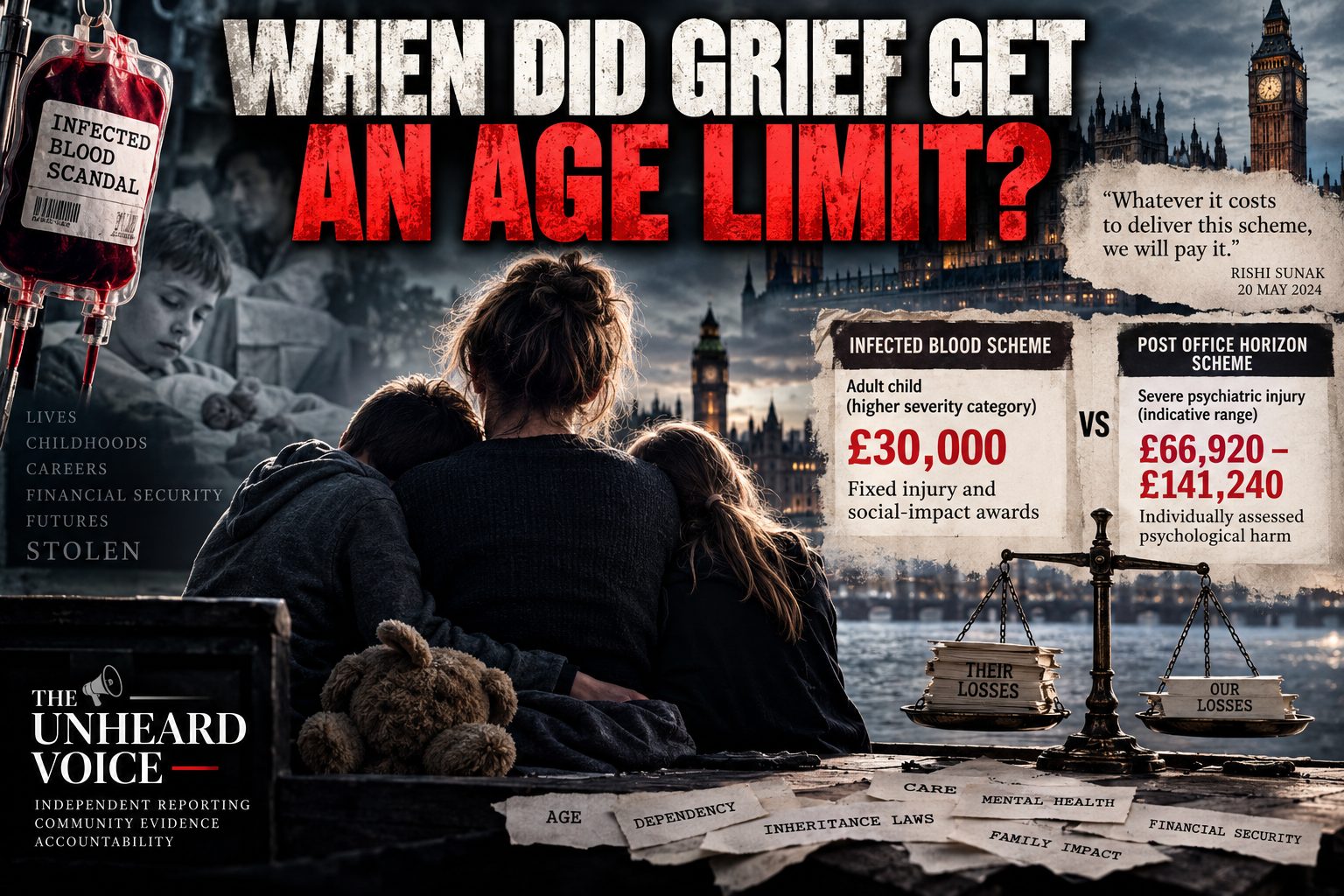
“A child's grief does not end at 18. A parent's grief does not diminish when their child becomes an adult. A sibling's sacrifice does not disappear because someone else was more seriously ill. And a carer's years of devotion do not become worthless because their loved one left no will.”
When Rishi Sunak stood before Parliament on 20 May 2024, he acknowledged one of the gravest injustices in British history. Thousands of people had died, families had been devastated, and generations had been left to carry the consequences of contaminated blood and blood products.
The government promised to put things right. Sunak told Parliament: “Whatever it costs to deliver this scheme, we will pay it.”
Those words were intended to reassure a community that had already endured decades of suffering, secrecy and broken promises. Yet more than two years later, families are still asking whether the compensation scheme truly reflects the damage caused by the scandal.
Because this tragedy did not just take lives. It changed the course of entire families' lives, often long before their loved ones died.
For children growing up with an infected parent, life was rarely ordinary. While other children were thinking about school, friendships and what they wanted to become, some were learning how to recognise illness, manage medication, cope with hospital admissions and live with the constant fear of losing someone they loved.
Many became carers before they were old enough to understand what caring really meant. Their childhoods were shaped by illness, anxiety and responsibilities that should never have belonged to them.
Yet when we examine the compensation scheme, one of the most difficult questions concerns age. Why should the age at which a child was affected make such a substantial difference to the compensation they receive?
The government's current compensation framework provides higher fixed injury awards for eligible children affected while under 18. In the higher infection-severity categories, an eligible child affected during childhood can receive £79,200 across injury, social-impact and autonomy awards, compared with £30,000 in the corresponding adult-affected category.
That is a difference of £49,200.
There is a legitimate argument that children experience particular disruption and vulnerability. But the consequences of losing a parent do not disappear on somebody's eighteenth birthday.
Imagine two young people who have spent years watching their father deteriorate from an infection contracted through NHS treatment. One was under 18 when the infection began to affect family life. The other was already an adult. Both may have witnessed the illness, both may have provided care, and both may carry the psychological consequences for decades.
Does the experience of the older child necessarily become less significant simply because they had reached adulthood?
And what happens when those consequences follow that person for the next 20 or 30 years?
The loss of a parent is not simply the loss of a relationship. For many children, it also means losing the financial foundation that might have helped them establish their future.
Most parents continue supporting their children long after they turn 18. They help with education, housing, childcare, financial emergencies and the everyday difficulties of adult life. They offer advice, stability and somewhere to turn when things go wrong.
For children who lost a parent to infected blood, that support may have disappeared before they ever had the opportunity to benefit from it.
Some lost the chance to complete their education because they were caring for a parent. Others entered adulthood already exhausted by years of illness and bereavement. Some struggled to maintain employment because the psychological consequences of what they had witnessed never truly left them.
The compensation scheme recognises certain financial losses, particularly where a child was under 18 when their infected parent died. There is also a supplementary route for some other bereaved affected people who can demonstrate financial dependency.
But what about the wider loss of opportunity? What about the adult child who never established a stable career, never had the financial backing other families could provide, or spent decades trying to rebuild a life disrupted before it had properly begun?
Where is the individual recognition of those consequences?
The same difficult questions arise for parents who lost their children.
Under the scheme, qualifying bereaved parents can receive an enhanced injury award where their infected child died before reaching 18, subject to the applicable eligibility conditions.
Parents whose children died in adulthood do not qualify for that particular enhancement.
A mother who loses her 17-year-old child can therefore receive a different fixed injury award from a mother whose child dies at 19, even where both deaths are attributable to infected blood.
How can we begin to measure the difference between those two losses?
A mother does not stop being a mother when her child becomes an adult. A father does not grieve less because his son or daughter reached 40 or 50.
Some parents spent decades watching their children suffer. They attended hospital appointments, provided care, fought for treatment and lived with the constant possibility of losing them. When that death finally came, their grief was no less real because their child had reached adulthood.
The government must explain why the compensation scheme draws these distinctions and whether they reflect the actual consequences of bereavement.
Then there are the brothers and sisters whose lives were also shaped by this scandal.
In many families, illness dominated everything. Hospital visits, treatment, deteriorating health and financial worries became part of everyday life. Parents were understandably consumed by the needs of the infected family member, often leaving siblings to manage their own fears and difficulties quietly.
Some learned not to ask for attention because someone else was suffering more. Others became carers themselves, sacrificing education, employment or opportunities to build independent lives.
For those who lost a brother or sister, the consequences could be devastating. They did not simply lose a sibling. They lost part of their childhood, their family stability and sometimes the future they had imagined.
The compensation scheme provides fixed awards for eligible siblings, but does not automatically compensate lost earnings simply because a sibling's employment was disrupted by family illness.
How do you place a value on someone who spent much of their life putting their own needs aside?
How do you calculate the impact of growing up in a household where illness, suffering and the possibility of death overshadowed everything else?
These experiences cannot always be measured through a standard tariff.
For widows, widowers and bereaved partners, the consequences can be equally complicated. Many spent years providing care before losing the person they loved. Some gave up employment, missed opportunities to build pensions or became financially dependent because caring responsibilities made ordinary working life impossible.
Others were left raising children alone while coping with bereavement, stigma and financial hardship.
The scheme recognises eligible bereaved partners through fixed awards and financial-loss calculations. But families are entitled to question whether those calculations adequately capture the consequences of years spent outside the workforce, particularly where someone has struggled to return to employment because of prolonged psychological harm.
For some people, rebuilding a stable working life after years of caring and bereavement was never straightforward. For others, it never happened at all.
Then we come to one of the most difficult issues of all: the treatment of unpaid carers.
Across the infected blood community, relatives sacrificed enormous parts of their lives to care for infected loved ones. Children cared for parents, parents cared for adult children, and brothers and sisters stepped into roles that would ordinarily have required professional support.
Many did so without payment, recognition or any expectation of reward.
Yet under the compensation framework, the Care Award for an infected person who has died is normally paid to their estate. Where there is no will, that money is distributed according to the rules of intestacy.
Those rules determine who inherits. They do not necessarily take account of who actually provided the care.
This means a daughter who spent years caring for her father might receive none of the estate's Care Award, while another relative who provided little or no care could inherit a share under the ordinary legal rules.
An eligible carer may receive a separate affected-person award, but that is not the same as being entitled to the compensation calculated for the care they personally provided.
For families dealing with estrangement, remarriage, blended households or complicated personal circumstances, this can create deeply painful outcomes.
The government has explained that estate distribution follows established inheritance arrangements and that identifying historic carers presents practical difficulties.
But surely a compensation scheme created to remedy an exceptional injustice should examine whether ordinary inheritance rules produce fair outcomes in exceptional circumstances.
What happens to the person who gave up their employment, social life and financial security to care for someone who has now died?
Who recognises that sacrifice when the law distributes the money elsewhere?
The psychological consequences of the scandal raise another fundamental question.
Many affected people describe spending decades living with anxiety, depression, traumatic memories and symptoms associated with post-traumatic stress disorder. Some have struggled to form relationships, maintain employment or feel secure in everyday life.
Others have lived through repeated bereavements, sometimes losing more than one family member to infections associated with contaminated blood products.
Specialist psychological support is now available to eligible people affected by infected blood, and that service may provide valuable help to people who have waited far too long to receive it.
But psychological treatment and compensation are not the same thing.
Therapy may help someone understand their experiences and manage the consequences. It cannot return the parent who died, restore the childhood that was lost or give someone back the decades they spent struggling to survive.
If a person has carried psychological harm for 20, 30 or even 40 years, how do we measure what that has cost them?
What value should be placed on the relationships that never developed, the career that never materialised or the financial stability that always remained beyond reach?
The scheme includes awards intended to recognise injury, social impact and loss of autonomy. It would be inaccurate to suggest psychological suffering receives no recognition.
But it is entirely reasonable to ask whether fixed awards adequately account for the duration and severity of that suffering, particularly where its consequences have affected almost every aspect of a person's adult life.
Not everybody experiences trauma in the same way. Not everybody has the same support network, financial circumstances or ability to recover.
Yet standardised compensation categories inevitably struggle to capture those differences.
When Other Scandals Are Compensated, Why Is the Approach Different?
The infected blood scandal is not the only national injustice that has forced the government to confront the consequences of institutional failure.
The Post Office Horizon scandal also destroyed livelihoods, damaged families and left people living with years of psychological distress.
Although the circumstances of these scandals differ, examining the compensation arrangements raises an important question about how individual suffering is assessed.
Under the Horizon Convictions Redress Scheme, eligible claimants can receive individually assessed compensation for psychiatric injury. The published assessment framework includes an indicative range of £66,920 to £141,240 for severe psychiatric harm, depending on the evidence and individual circumstances.
Those figures relate to eligible claimants under the convictions scheme, rather than being automatic payments to family members.
However, the government has also established a dedicated Horizon Family Members Redress Scheme, which provides for an individually assessed personal injury route.
This is particularly significant because the government's published proposals acknowledge that some relatives need an assessment tailored to their individual circumstances rather than a fixed payment.
Eligible applicants may be able to provide medical evidence showing the extent of their psychological injury. Where certain serious ongoing medical conditions exist without historic evidence, the scheme's proposals provide for a new medical assessment.
The framework also allows consideration of other losses caused by the personal injury.
Meanwhile, under the infected blood compensation framework, an eligible adult child in one of the higher infection-severity categories may receive £30,000 in fixed injury and social-impact awards, without a general route for increasing those awards according to an individual psychiatric assessment.
These amounts are not directly comparable. They compensate different categories of loss under schemes with different eligibility rules.
Nevertheless, the contrasting approaches raise an important question.
If psychological injury arising from one institutional scandal can be assessed individually, why should families affected by infected blood not have a comparable opportunity to demonstrate exceptional, lifelong psychological harm?
What happens to the person who became a carer during childhood, lost a parent, struggled to complete education and spent decades unable to maintain stable employment?
What happens to the widow whose psychological health never recovered from years of caring and bereavement, or the sibling whose opportunities disappeared beneath the demands of another family member's illness?
These are not necessarily ordinary experiences of grief. In some cases, they may involve identifiable psychiatric injury, disrupted education, reduced earning capacity and decades of financial disadvantage.
The issue is not whether victims of the Post Office scandal deserve their compensation. They do.
Nor should victims of different scandals be placed in competition with one another.
The question is why the government has adopted different approaches to assessing individual psychological harm and whether those differences can be justified.
If the state accepts that one person's psychological injury may be significantly more severe than another's, why should affected families within the infected blood scheme have such limited scope for an individual assessment of that distinction?
A fixed award may provide consistency and allow claims to be processed more efficiently. But consistency alone does not establish that compensation reflects the full consequences of the injury suffered.
And this brings us back to the central issue.
The infected blood scandal caused harm that extended far beyond the infected individuals themselves. Families lived with the consequences for decades. Some lost parents and children. Others lost partners, siblings, employment, education, financial independence and opportunities that can never be recovered.
The government has acknowledged those harms and established a compensation scheme with substantial funding.
But the existence of compensation does not automatically mean that every consequence has been adequately addressed.
Nor does offering psychological support settle questions about decades of economic loss, missed opportunities or lifelong trauma.
The Cabinet Office must be prepared to explain how the affected-person tariffs were calculated, why certain age distinctions were chosen and what evidence was used to assess the true financial and psychological consequences for bereaved families.
It must explain why parents whose children died in adulthood cannot qualify for the same bereavement enhancement as parents whose children died before 18.
It must explain how the scheme addresses adult children who lost financial security, siblings whose working lives were disrupted, and carers whose sacrifices are not reflected in the distribution of estate awards.
And it must explain what meaningful options exist for people whose circumstances are far more severe than the standard compensation categories appear to anticipate.
The difference between the Horizon and infected blood compensation approaches warrants particular scrutiny. The government should explain the evidence and policy reasoning behind offering individually assessed personal-injury compensation in one framework while relying predominantly on fixed awards for affected relatives in another.
These questions should not be dismissed as dissatisfaction with compensation amounts.
They concern the very purpose of the scheme.
Rishi Sunak promised that whatever it cost to deliver compensation, the government would pay it.
Families now deserve to know whether the rules governing that compensation truly account for the consequences of what happened.
Because a child's grief does not end at 18. A parent's grief does not diminish when their child becomes an adult. A sibling's sacrifice does not disappear because someone else in the family was more seriously ill.
And the years spent caring for a dying loved one do not become less valuable because that person left no will.
For many affected families, the consequences of the infected blood scandal did not end when their loved ones died. In some respects, that was when another lifetime of difficulties began.
No amount of compensation can restore what was taken. But that does not remove the government's responsibility to examine whether the financial, psychological and personal consequences have been properly recognised.
The question is not simply how much grief is worth. It is why a scheme intended to deliver justice still leaves families asking whether the lives they lost while caring, grieving and surviving have been fully counted?
And until those questions are answered, the promise to put things right will remain open to challenge.
The Unheard Voice — Independent reporting, community evidence and accountability.