HIV Was Not the End of the Story: What AIDS Progression Really Looked Like
For many people infected through contaminated blood, an HIV diagnosis was only the beginning. This article looks at what progression to AIDS could mean in real life — opportunistic infections, severe weight loss, cancers, repeated hospital admissions and profound physical decline.
By Anonymous · Sep 26, 2026
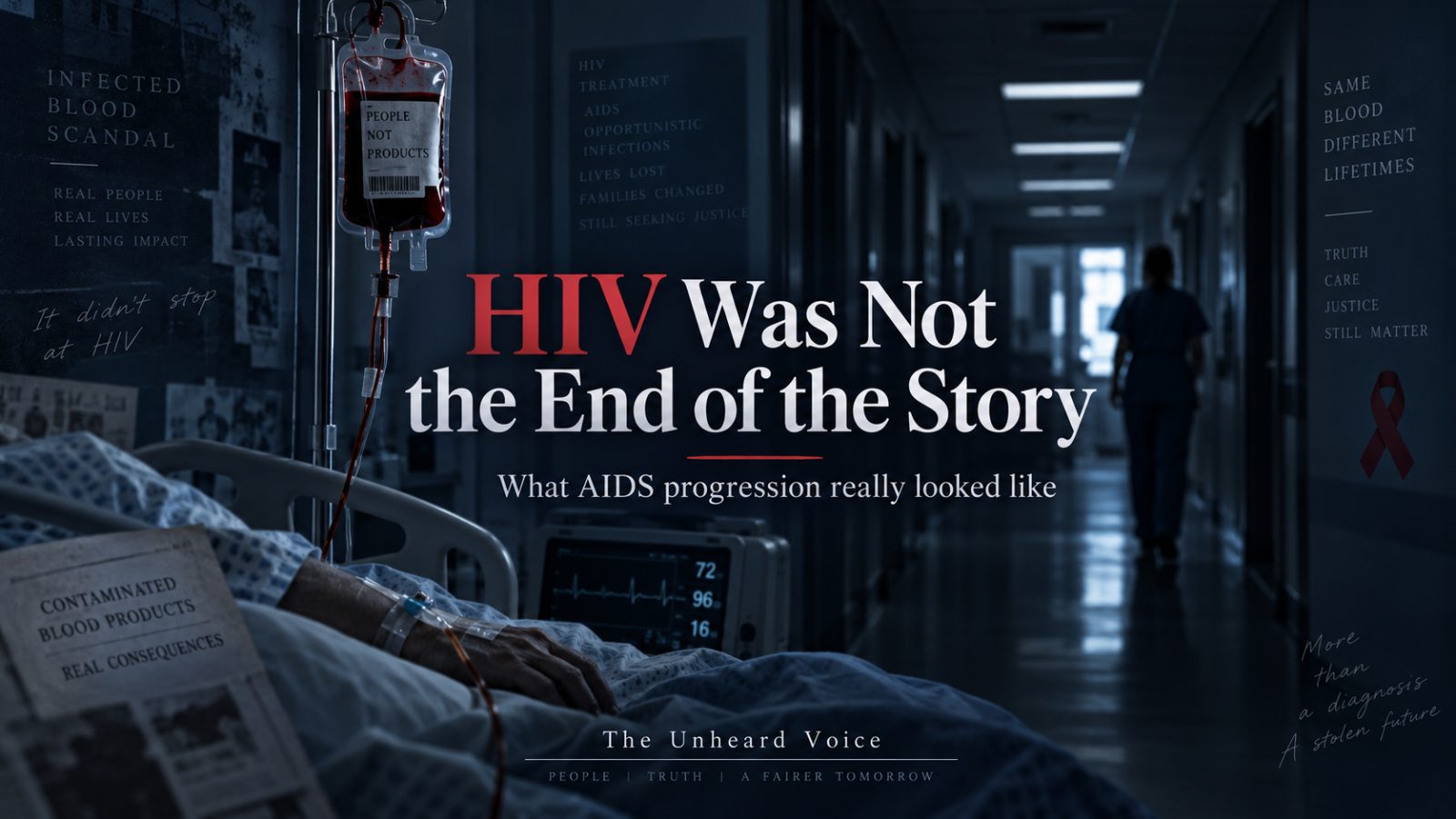
“HIV was the diagnosis. AIDS was the progression — and the final chapters of that illness deserve to be seen.”
For thousands of people caught up in the infected blood scandal, being diagnosed with HIV was not the end of the medical story.
For some, it was the beginning of years of worsening illness.
HIV and AIDS are connected, but they are not the same thing. HIV is the virus that attacks the immune system. AIDS describes the most advanced stage of HIV infection, when the immune system has been severely weakened and serious opportunistic infections or certain cancers can develop.
That distinction matters.
Because when we talk about the harm caused by infected blood, simply recording that somebody was infected with HIV does not necessarily describe what happened to them afterwards.
HIV could progress over many years
Without effective treatment, HIV progressively damages the immune system.
A person may initially have few symptoms or none at all. Over time, however, the immune system can become increasingly compromised. Symptoms associated with progression can include weight loss, persistent fever, diarrhoea, coughing and swollen lymph nodes.
At the most advanced stage, people become vulnerable to illnesses that a healthy immune system would ordinarily be better able to fight.
These can include tuberculosis, severe bacterial infections, cryptococcal meningitis and certain cancers including lymphoma and Kaposi’s sarcoma.
The NHS also explains that untreated HIV can eventually lead to serious illnesses including pneumonia, tuberculosis and cancer, a stage described as advanced HIV, late-stage HIV or AIDS.
That is not simply a change in terminology.
It can represent an enormous change in somebody’s health and quality of life.
What advanced disease could mean in everyday life
Medical definitions matter, but they do not fully describe what advanced HIV disease could look like inside a home or hospital room.
It could mean repeated infections, extreme tiredness, profound weight loss, long hospital admissions, difficulty eating, recurrent fungal or bacterial infections and cancer.
For families, it could also mean becoming carers.
Watching somebody who had already lived for years with HIV become dramatically more unwell.
Seeing increasing dependence on medical treatment.
And living with the knowledge that an infection acquired through NHS treatment had progressed into something far more serious.
Modern HIV treatment has transformed that picture for many people. Effective antiretroviral therapy can suppress the virus, protect the immune system and allow people living with HIV to live long and healthy lives.
But many of those infected through contaminated blood lived through an earlier era of HIV medicine.
Their experience cannot simply be judged through the lens of what HIV treatment looks like today.
AIDS was a clinical progression, not another name for HIV
This point can easily become blurred when decades of medical history are condensed into a compensation file.
HIV is the infection.
AIDS is an advanced clinical stage of that infection.
Historically, an AIDS diagnosis could mark a significant deterioration. It might reflect serious opportunistic disease, substantial immune suppression or an AIDS-defining cancer.
So when somebody’s records show that they progressed from HIV infection to AIDS, that information is not merely a different label attached to the same condition.
It tells us something about the severity of their illness.
The infected blood history makes that distinction particularly important
The Infected Blood Inquiry documented the experiences of people infected with HIV and hepatitis through contaminated blood and blood products, alongside the impact on their families.
Those experiences stretched across decades.
Someone infected in childhood or early adulthood could live through several very different stages of disease.
There could be the initial infection.
The diagnosis.
Years of monitoring.
Treatment complications.
Immune deterioration.
Opportunistic infections.
AIDS.
And, for many families, death.
Collapsing that entire history into the single word “HIV” risks losing the reality of what happened later.
The medical records may tell a much bigger story
This is why old records matter.
A medical file may contain evidence of repeated infections, falling CD4 counts, prolonged hospitalisation, severe weight loss, oral or oesophageal infections, pneumonia, cancers or an explicit diagnosis of AIDS.
Individually, those entries can look like isolated episodes.
Together, they may show a clear progression of disease.
That fuller history matters when trying to understand the actual harm suffered by somebody infected through contaminated blood.
The question should not stop at:
Did this person have HIV?
It should also ask:
What happened to them because of it?
How far did the disease progress?
What additional illnesses did they develop?
How much treatment did they require?
How much did their physical condition change?
And what did their family witness and carry alongside them?
Recognition should reflect the whole medical journey
There is a danger in discussing historical HIV infection as though diagnosis itself captures the entirety of the injury.
It does not.
For some people, HIV remained clinically stable for significant periods.
For others, it progressed into severe immunodeficiency and AIDS-defining illness.
Those are materially different medical histories.
Any system trying to recognise the harm caused by infected blood needs to be capable of seeing that distinction.
Not because one person's suffering needs to be compared with another's.
But because the medical consequences themselves were different.
A person who progressed to AIDS did not simply remain at the point of their original HIV diagnosis.
Their disease progressed.
Their health changed.
Their treatment burden changed.
And often, so did the lives of everyone caring for them.
We should not erase the final chapters
There is a temptation, when telling the infected blood story, to focus on the moment of infection.
That moment matters enormously.
But for many families, the most devastating chapters came years later.
The hospital admissions.
The opportunistic infections.
The cancers.
The weight loss.
The frailty.
The repeated crises.
The final illness.
Those experiences are part of the infected blood scandal too.
If we recognise only that somebody was infected with HIV, but fail to recognise what happened when that infection progressed, we risk reducing a long and complicated medical history to a single diagnosis.
HIV was not the end of the story.
For some people, AIDS became another chapter altogether.
And that chapter deserves to be seen.