Too Poor to Claim? The Hidden Legal Costs Standing Between Families and Infected Blood Compensation
When probate, deputyship and medical certification become obstacles to compensation, is justice truly accessible to everyone?
By Anonymous · Nov 20, 2026
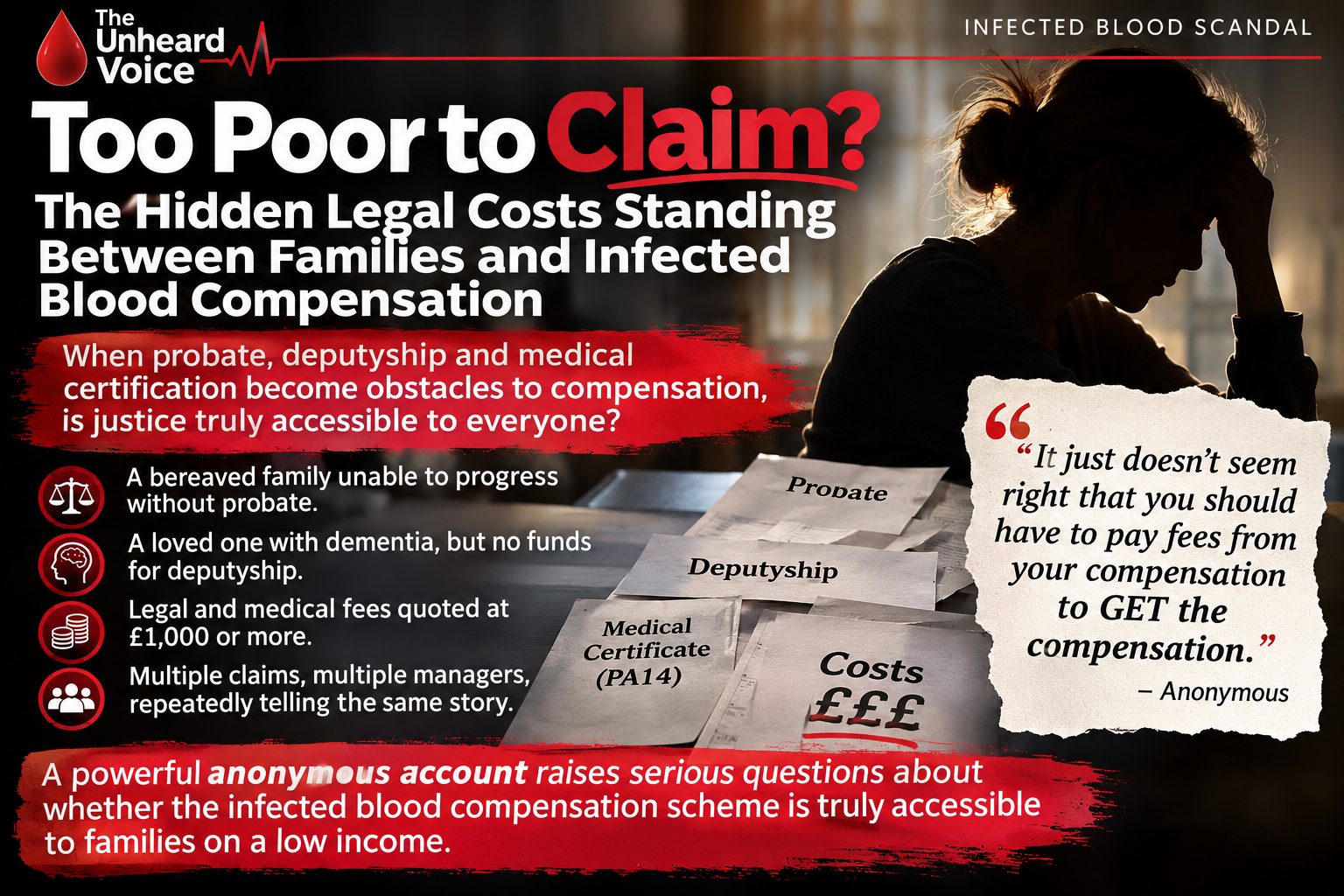
“It just doesn't seem right that you should have to pay fees from your compensation to GET the compensation does it?” — Anonymous contributor, The Unheard Voice
An investigation by The Unheard Voice | Anonymous community testimony
For families affected by the infected blood scandal, compensation was supposed to represent recognition, accountability and a measure of justice after decades of suffering.
But what happens when accessing that compensation requires money a family simply does not have?
What happens when a loved one has died, another has developed dementia, and the family member left trying to navigate the system cannot afford the legal processes standing in their way?
One family has shared its experience anonymously with The Unheard Voice.
Their account raises serious questions about whether the compensation system is sufficiently accessible to families experiencing financial hardship, particularly where probate, mental capacity and multiple claims are involved.
A family already carrying decades of suffering
The family has been affected by multiple infections linked to contaminated blood.
One sibling, who has haemophilia, acquired serious viral infections following treatment with blood products. Other family members were also infected or affected.
The consequences have continued across generations.
Their mother died several years ago. Their father subsequently developed dementia and now lives in residential care.
The family member who contacted us is attempting to navigate several compensation claims, involving different relatives, different entitlements and different claims managers.
It is a complicated situation, but that complexity is precisely why effective support matters.
The probate problem
When their mother died, the family understood that probate was unnecessary because her estate contained no significant assets requiring it.
Years later, a compensation claim has changed that position.
IBCA has asked for evidence of legal authority to act on behalf of the deceased person's estate.
The father was named as executor in the will, with other relatives nominated to act in certain circumstances. But his dementia has introduced an additional legal obstacle.
The family has been asked to obtain medical evidence confirming his inability to act.
They have encountered difficulties securing the necessary documentation from his GP, including repeated attempts to have probate forms completed.
The process has already involved paperwork, correspondence, additional appointments and weeks of uncertainty.
And none of it has yet brought the family closer to receiving compensation.
When dementia becomes another financial obstacle
The father's own compensation claims have also encountered difficulties.
Although a family member was initially assisted in setting up identity verification, progression of the claims has reportedly been held up by the lack of formal legal authority to act on his behalf.
The family has been quoted substantial costs for obtaining deputyship, with potential additional legal fees.
For someone living on a limited income, these costs are not minor inconveniences.
They can become barriers that prevent a claim progressing at all.
The family member explained that even the suggestion of contacting multiple solicitors was overwhelming.
After years of illness, bereavement and repeated explanations of their family's medical history, having to tell the story again to another professional felt almost unbearable.
This is not simply an administrative issue.
It is about the emotional and financial burden placed on people who are already exhausted.
Compensation should not require financial security first
According to the family's account, an IBCA claims manager sought advice from the authority's legal team.
The suggested route was to find a solicitor willing to defer payment until compensation became available, with legal costs potentially recovered from the award.
That suggestion raises an uncomfortable question.
Why should someone who cannot afford the legal process have to rely on finding a solicitor willing to take the financial risk of helping them access compensation?
And if legal costs are ultimately deducted from an award, how much compensation would actually remain?
There are existing arrangements for reimbursement of certain probate expenses and court fee reductions for eligible low-income applicants.
But reimbursement after a claim succeeds does not necessarily help someone who cannot afford to start the process.
Nor does it automatically address deputyship costs, medical certification charges or the practical difficulty of finding appropriate legal assistance.
The distinction matters.
A system can offer financial assistance on paper while remaining difficult to access in practice.
Different claims managers. The same family history.
There is another troubling feature of this family's experience.
Multiple claims managers have reportedly contacted the family concerning different claims.
Rather than receiving coordinated support, the family member describes being repeatedly asked to provide information about existing claims, including reference numbers and the identities of other claims managers.
They are left trying to reconstruct information IBCA may already hold.
For a family with several infected and affected members, this fragmentation creates considerable additional work.
It also means repeatedly revisiting painful family history.
Each telephone call can require another explanation of infections, diagnoses, deaths and the consequences of the scandal.
How many times should one family have to explain the same tragedy before the system recognises that their claims are connected?
The emotional cost of claiming
Perhaps the most concerning part of the testimony is the effect the process is having on the person trying to help their family.
They describe feeling depressed, exhausted and unable to find the motivation to continue dealing with the paperwork.
This is not a person refusing to cooperate.
It is someone who has repeatedly attempted to comply, sought help and followed instructions, only to encounter another obstacle.
The infected blood scandal has already taken decades from families.
The compensation process should not become another source of avoidable suffering.
What the official rules actually say
Probate and deputyship are legal safeguards. They exist to establish who has authority to act for another person or their estate, and to protect people who may lack decision-making capacity.
They cannot simply be ignored.
However, official guidance confirms that applicants with low incomes may qualify for help with certain court fees.
The probate process also provides a medical certificate route, using form PA14, when a named executor cannot act because of a mental health condition or impairment.
Form PA15 concerns the renunciation of an executor's rights. Whether it is appropriate in an individual case depends on the executor's circumstances and legal capacity.
These distinctions matter, especially when families are being asked to navigate the process without specialist assistance.
The question is not whether legal safeguards should exist.
It is whether the compensation system provides adequate practical and financial support to help families comply with them.
Questions The Unheard Voice is putting to IBCA and the Government
We believe this account warrants clear answers.
What practical assistance is available when a claimant cannot afford probate, deputyship or medical certification costs?
Can IBCA arrange or fund necessary legal assistance upfront in cases of genuine financial hardship, rather than relying on reimbursement after compensation is received?
What support is available where a claimant has dementia and no existing lasting power of attorney or deputyship?
Can related claims involving the same family be coordinated, with appropriate consent and data protection safeguards, to reduce repeated requests for evidence?
What happens when an otherwise eligible family cannot progress because it lacks the money needed to establish legal authority?
How does IBCA identify financially vulnerable claimants and ensure their claims do not remain indefinitely unresolved?
These are questions about access to justice, not requests to disregard the law.
Justice must not depend on the money in your bank account
The infected blood scandal harmed people from every background.
Families did not choose to become infected. They did not choose to lose loved ones. They did not choose decades of illness, caring responsibilities or financial hardship.
A compensation scheme created in response to those harms must recognise that not every family has the resources, knowledge or emotional resilience to navigate complex legal procedures independently.
A person should not be left wondering whether they can afford to establish their right to claim.
And no family should feel that poverty makes justice inaccessible.
The Unheard Voice believes this issue requires urgent examination by IBCA, the Cabinet Office and those responsible for ensuring that the compensation scheme can be accessed fairly.
We will be seeking a formal response on the financial and practical barriers described in this testimony.
Because compensation that exists in principle but remains out of reach in practice raises a fundamental question:
What is the value of justice if the people who need it cannot afford to reach it?
Have you experienced something similar?
The Unheard Voice would like to hear from infected individuals, affected people and bereaved families who have encountered financial barriers involving probate, deputyship, legal fees or access to compensation.
You can share your experience privately and request anonymity.
The Unheard Voice — Giving the infected blood community a voice.
https://theunheardvoice.uk
Editorial note: This article is based on testimony provided privately by a community member who has requested anonymity. Individual experiences and reported conversations with IBCA have not yet been independently established. We have withheld identifying details and will seek responses from the relevant authorities. Legal requirements and available support may vary according to the circumstances of each claim.