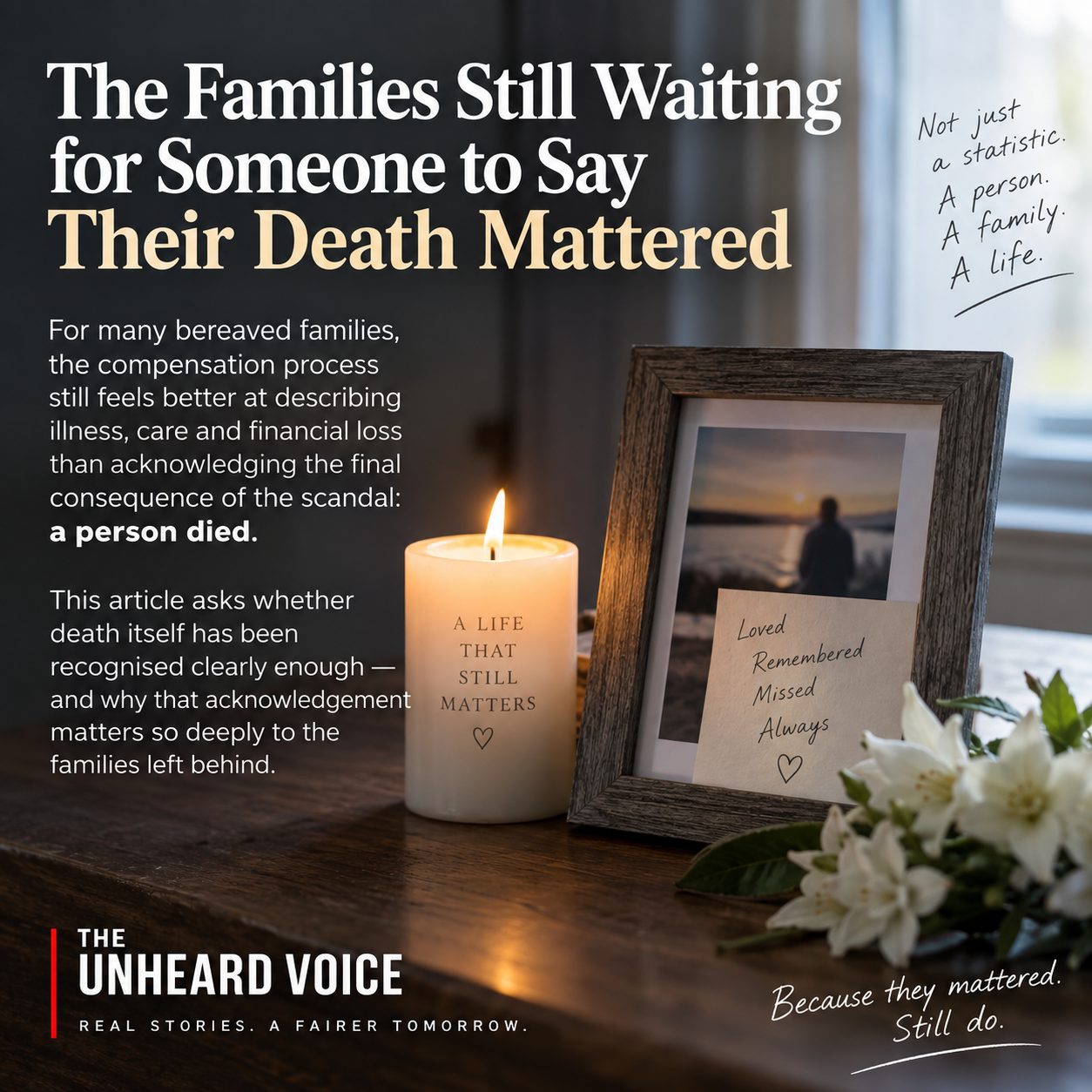
The Families Still Waiting for Someone to Say Their Death Mattered
For many bereaved families, the compensation process still feels better at describing illness, care and financial loss than acknowledging the final consequence of the scandal: a person died. This article asks whether death itself has been recognised clearly enough — and why that acknowledgement matters so deeply to the families left behind.
By Anonymous · Sep 30, 2026
“Behind every deceased claim is somebody who was once alive — somebody who was loved, and somebody whose absence is still felt today.
For thousands of families affected by the infected blood scandal, the loss did not end with a diagnosis. It ended with a death.
A father. A mother. A husband. A wife. A brother. A sister. A child.
For many bereaved families, the compensation process still feels better at describing infection, illness, care and financial loss than it does at acknowledging the final consequence of what happened: a person died.
That distinction matters because death is not simply another stage of injury. It is permanent. It changes families forever. It creates an absence that continues long after medical records have been closed, compensation calculations have been made and official processes have moved on.
Some families have lived with that absence for decades. Children grew up without parents. Parents buried sons and daughters. Partners became widows and widowers. Brothers and sisters lost the people they expected to grow old alongside.
Many families also became carers before they became bereaved. They watched people deteriorate, attended appointments, managed medication, fought for treatment and tried to hold family life together while the person they loved became increasingly unwell.
Then came the grief.
For some, that grief was followed by years of campaigning, inquiries, paperwork and repeated attempts to have what happened recognised. The Infected Blood Inquiry finally forced the country to confront the scale of the scandal and the devastating consequences for those infected and affected.
But for many bereaved families, one question still remains: where is the recognition of the death itself?
The compensation scheme contains different awards intended to recognise injury, care, financial losses and the impact on affected family members. Those awards matter.
But some families still feel that none of them quite answers the simplest question they carry: was the death itself recognised?
That question is not about putting a price on a life. No compensation scheme could ever do that. It is about acknowledgement.
When someone dies because of infected blood, the harm does not end at the final medical stage recorded before their death. A life ended, and the consequences of that death then spread through the whole family.
The child who lost a parent. The partner who lost the person they had built a life with. The mother or father who buried their child. The sibling who lost part of their shared history. The family who had already spent years living with illness before being left to deal with bereavement.
Recognition matters because compensation is not only about financial calculation. It is also about what the state chooses to acknowledge.
The infected blood scandal caused illness, disability, financial loss, trauma and bereavement. And it caused death.
Families should not feel they have to keep explaining why that final consequence deserves to be recognised in its own right. They should not feel that the person they lost has been reduced to a calculation based only on what happened before they died.
There are legitimate questions around how any separate recognition of death would operate. Would it belong to the estate or to bereaved relatives? How would it interact with existing awards? How would the scheme avoid counting the same harm twice?
Those questions would need careful answers, but complexity should not prevent the underlying issue from being discussed.
For many families, this is not about creating another headline figure. It is about something much more basic.
They want to know that when the history of this scandal is finally translated into compensation, the people who died are not remembered only through medical stages, care calculations or lost income.
Behind every deceased claim is somebody who was once alive. Somebody who had plans. Somebody who had relationships. Somebody who was loved. Somebody whose absence is still felt today.
And decades after many of those deaths, some families are still waiting for the system to say something very simple:
Their death mattered.
A question policymakers should address
The next step does not have to begin with a fixed answer. It should begin with transparency.
Government and the Infected Blood Compensation Authority should explain clearly how death is recognised within the current compensation framework, where that recognition sits within existing awards, and whether any gaps remain for bereaved families.
If ministers and officials believe the present scheme already provides sufficient recognition, they should set out that reasoning in plain language and show how it works in practice. If evidence from bereaved families points to a genuine gap, that evidence should be considered openly and any policy options assessed carefully for fairness, consistency and the risk of double-counting existing awards.
A focused review or published policy explanation would give families something they have been missing for too long: a clear answer to a clear question.
Because whatever the eventual policy conclusion, bereaved families deserve to understand how the system recognises the fact that someone they loved died.