When the Queue Stops Making Sense: Why Is IBCA’s Invitation Sequencing Still So Unclear?
IBCA says it is now in a better position to tell people when their claims are expected to start. But for many affected families, the latest update still does not explain how invitations are actually being sequenced — or why younger people appear to be receiving invitations while some people in their 70s remain waiting. The Unheard Voice has already asked IBCA for clarification and is awaiting a response.
By Anonymous · Sep 24, 2026
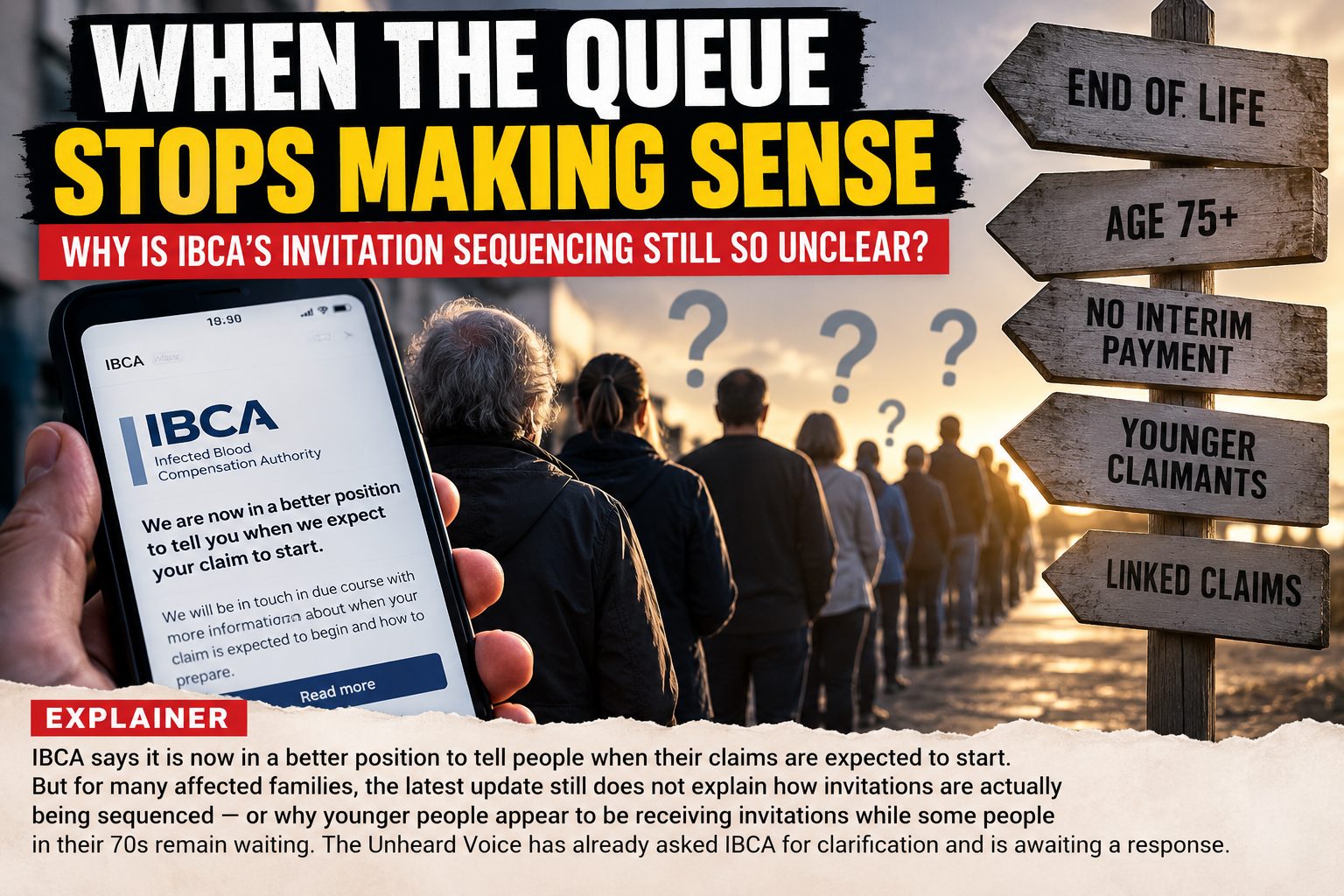
Nobody receiving an invitation should feel guilty. The problem is not who has been invited — it is that the community still cannot understand why one person is called forward while another is left waiting.
When the Queue Stops Making Sense A new IBCA update says the Authority is now in a better position to tell people when their claims are expected to start. But within hours, members of the infected blood community were again asking the same question: why does the invitation sequence still appear impossible to understand?
The Unheard Voice is already awaiting clarification from IBCA Chief Executive David Foley about how invitations are being sequenced.
That request was made before the latest community update was issued.
Now, rather than settling the issue, the new email has intensified it.
IBCA says its ambition is to bring 5,000 claims to decision between April 2026 and March 2027 and says this means it is now in a better position to tell registered people **when it expects their claim to start**.
For infected people and those representing deceased infected estates, the update does provide an important outer timeframe: IBCA says those who have registered their intent to make an infected claim will be asked to start before **31 March 2027
For affected people, however, the position remains far less clear.
IBCA says more affected claims will enter the service from October, that end-of-life cases have already been brought in and that people aged over 75 will begin to be brought into the service from the beginning of October. After that, it says claims will continue to be prioritised according to the recommendations of the Infected Blood Inquiry.
What the update does not provide is a timetable showing how those priorities translate into actual invitations.
And that gap is becoming increasingly difficult for the community to ignore.
The Unheard Voice has been contacted by people who initially believed the latest email might finally give them a clearer indication of when their own claim would begin.
For some, there was a brief moment of hope.
They then realised the same general update had been received across the wider community.
At the same time, people continue comparing invitations.
The Unheard Voice has seen accounts of people under 50 receiving invitations while other people in their 70s say they are still waiting.
We have also seen accounts involving people linked to previous interim payments alongside others who say no interim payment was received and who remain outside the process.
Those accounts do not, by themselves, prove that IBCA has breached its prioritisation policy.
Different claim types can move in parallel. Individual cases may involve circumstances that are not visible to other members of the community.
But that is precisely why transparency is now so important.
People across the infected blood community speak to one another every day.
They know who is elderly.
They know who is approaching the end of life.
They know which families received interim payments.
They know approximately when people registered.
And increasingly, they know who is receiving invitations.
When that lived picture does not appear to match the published priorities, people naturally start asking questions.
Those questions are now causing distress in both directions.
Older people who remain waiting are becoming increasingly anxious about whether they have somehow been overlooked.
Meanwhile, some younger people who have received invitations have said they feel uncomfortable or guilty about progressing while knowing that people much older than them remain outside the process.
That guilt does not belong with them.
Nobody receiving an invitation has done anything wrong.
They did not decide the sequencing.
They did not choose to be brought forward.
The responsibility for explaining why one person is invited before another lies with the organisation operating the scheme.
And this is where IBCA now has an opportunity to change the temperature completely.
Why not simply be fully transparent?
Explain the sequencing.
Explain the different queues.
Explain how registration dates, age, health, interim payments, linked family claims and different claim types interact.
Explain why somebody younger may receive an invitation while somebody in their 70s remains waiting.
If there are operational reasons, say what they are.
If the published priorities do not create one straightforward queue, explain that clearly.
If circumstances mean exceptions occur, explain those too.
Full transparency and candour may not remove the wait, but it could remove some of the fear created by not understanding it.
This community has already endured too much uncertainty and too much trauma.
People should not have to spend every day comparing Facebook posts, forum comments and private conversations trying to work out whether they have been forgotten.
They should not have to reconstruct IBCA's invitation system themselves.
And people fortunate enough to receive an invitation should not be left feeling guilty because nobody can explain why their turn came first.
The Unheard Voice is hearing from people who are exhausted by the uncertainty, deeply anxious about the wait and, in some cases, describing themselves as reaching breaking point.
That should matter.
So how much longer can this invitation confusion continue?
What will it take before the sequencing is laid out with enough clarity that people no longer have to guess?
IBCA's latest email says the Authority is now better placed to tell people when their claims are expected to start.
The community now needs that promise translated into something meaningful.
Not another broad reassurance.
Not another list of priority groups.
A clear explanation of how the queue actually works.
Because if greater transparency could ease even some of the anxiety already being caused, there is a simple question IBCA should now answer:
Why not give the community that transparency?