Missing records. Broken lives. IBCA must explain its decisions.
IBCA says infected blood claims are assessed on the balance of probabilities. When medical records are missing or destroyed, families deserve to understand how the remaining evidence has been weighed—and why a claim has been refused.
By Anonymous · Oct 23, 2026
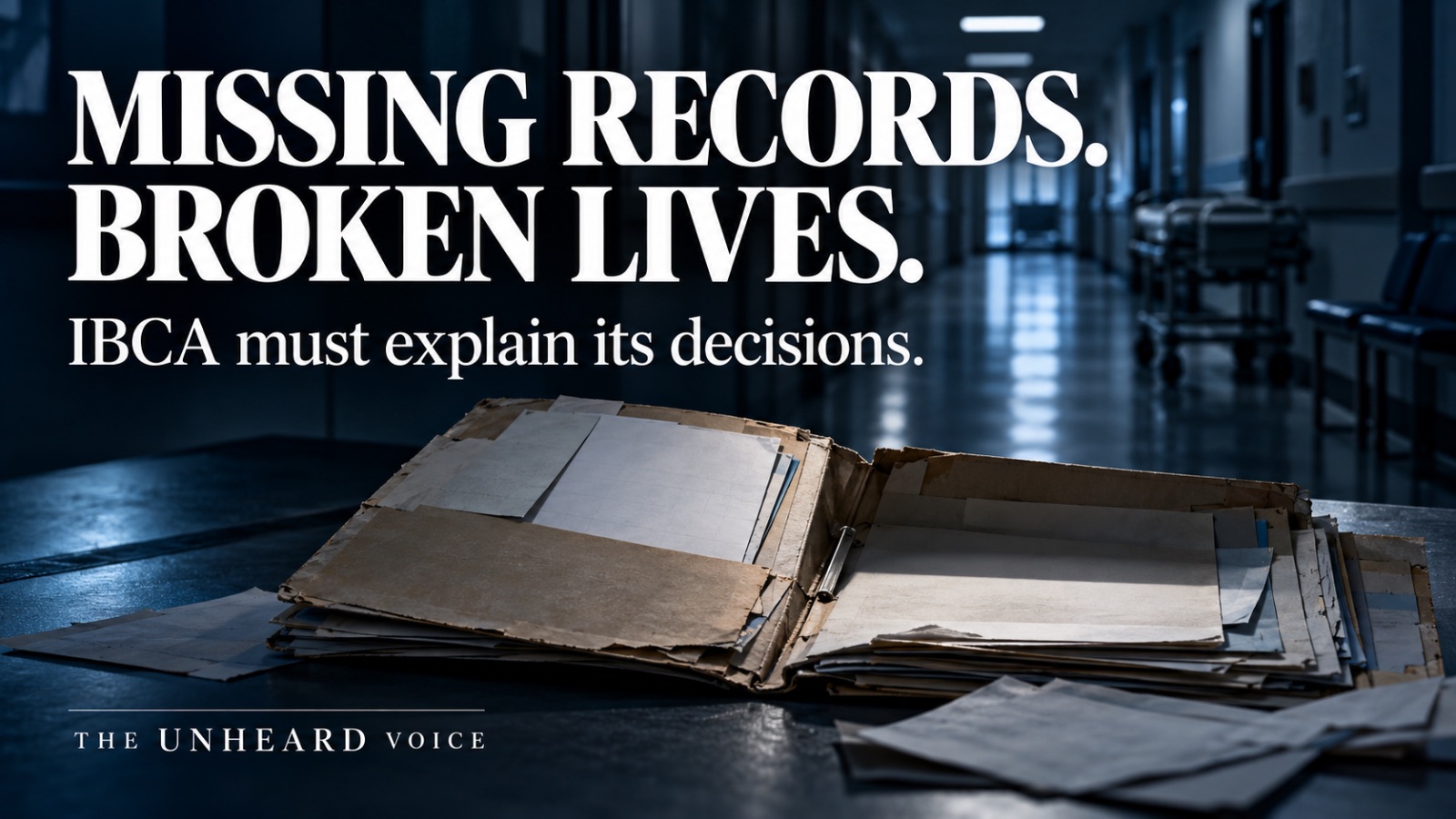
“Families cannot produce records that no longer exist. IBCA must be able to explain what it did with the evidence that remains
Families cannot recreate a medical history that the institutions responsible for keeping it can no longer produce.
The Government has acknowledged that historic medical records will not always survive. In a parliamentary answer on 13 November 2025, it confirmed that eligibility for infected blood compensation would be determined on the balance of probabilities and that IBCA would assist people whose records had been lost or destroyed.
That acknowledgement must have practical meaning when a claim is assessed.
In its community update of 8 October 2026, IBCA explained that claim managers consider the available information together and decide whether someone is more likely than not to be eligible. It also said it would seek information from other sources where records were incomplete and take account of what claimants themselves tell it.
These are published commitments. Families are entitled to scrutinise whether the explanations they receive reflect them.
The balance of probabilities does not require certainty. It still requires sufficient evidence to establish the relevant eligibility conditions.
Something being possible does not automatically make it probable. A history of transfusion, a later diagnosis or the absence of a documented alternative may support a claim, but none necessarily settles every eligibility question by itself.
That is precisely why the reasoning matters.
Where a claim is refused, the family deserves an understandable explanation of what the evidence establishes, what remains uncertain and why the relevant requirements have not been met.
Which evidence carried weight? Which evidence was discounted? What medical reasoning supported the assessment? How did missing records affect the conclusion?
A family should not have to guess how a decision about their loved one was reached.
A published account from Middleton Law illustrates why examining the evidence closely can matter.
On 20 October 2026, the firm described representing a person whose hepatitis C claim had initially been questioned because the infection might have been acquired abroad, despite a documented UK blood transfusion. According to the firm, its examination of the records and representations about the likely source led to the position being reversed, the claim being accepted and interim payments being made. This is the solicitor’s published account, rather than an independently published tribunal judgment.
That account does not establish a failure across the entire scheme. It does demonstrate the importance of scrutinising an initial assessment and giving claimants a meaningful opportunity to challenge its reasoning.
There are also questions IBCA should answer about how its guidance works in practice.
Its hepatitis B guidance recognises that information may be missing because records were lost or destroyed, tests did not exist or follow-up testing never happened. It requires a clear diagnosis in a clinician’s statement and provides for an IBCA clinical adviser to consider all available information where the diagnosis remains unclear.
The requirements for a clinician’s diagnostic statement and IBCA’s overall assessment of eligibility are distinct questions. The guidance alone does not establish that IBCA is applying an unlawful standard.
But IBCA should explain how those processes work together when the surviving evidence is incomplete.
For bereaved families, the question is stark: how is a historical infection assessed when the person has died, further examination or fresh blood testing is impossible and parts of the medical record no longer exist?
The eligibility conditions still need to be established. Families deserve to know what surviving evidence can establish them and how uncertainty is assessed.
A daughter cannot order a blood test retrospectively. A widow cannot recreate a hospital file. No amount of persistence can recover a document that has been destroyed.
Those realities should be addressed explicitly when decisions are explained.
The Unheard Voice calls on IBCA to explain how it weighs incomplete records, witness accounts, clinical opinions and competing explanations.
That includes distinguishing between evidence that contradicts a claim and information that is simply unavailable. Missing information does not automatically establish eligibility. Equally, its absence does not, by itself, establish that the claimed event never happened.
The Cabinet Office should also answer for whether the scheme’s requirements work fairly in the historical circumstances they were designed to address.
Public money requires proper scrutiny. Decisions refusing compensation deserve the same scrutiny.
These assessments concern illness, bereavement and events that have shaped entire lives. An explanation that leaves a family unable to understand why the evidence fell short is inadequate.
IBCA’s published commitment to the balance of probabilities must be visible in its reasoning.
Families cannot produce records that no longer exist. IBCA must be able to explain what it did with the evidence that remains