The Widows Who Were Expected to Simply Carry On
After losing husbands and partners to illnesses linked to infected blood, many widows were left carrying grief, caring responsibilities, financial pressure and family life with little recognition of what had happened to them.
By Anonymous · Sep 26, 2026
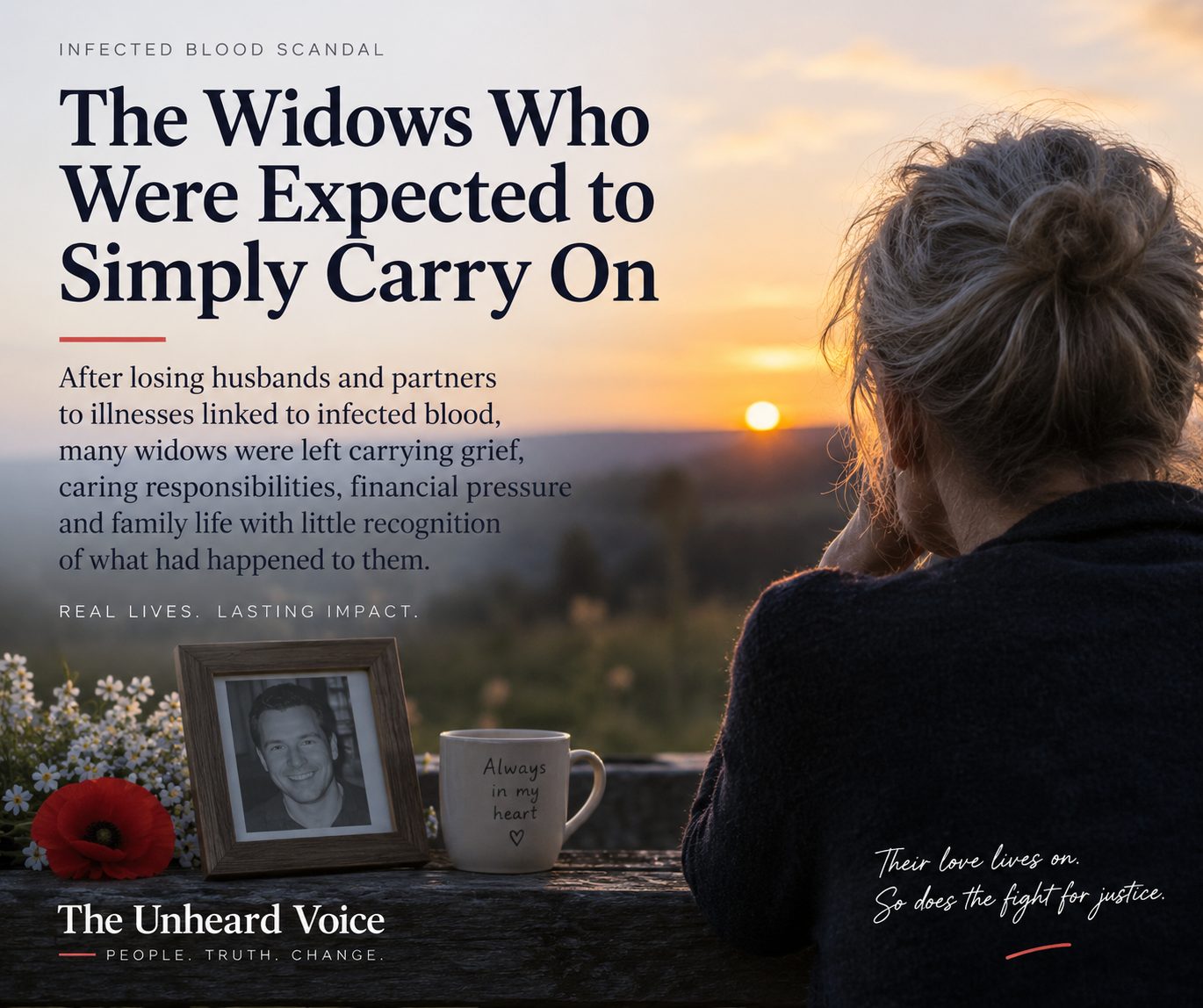
“Carrying on was never the same as being untouched.”
For many widows and bereaved partners affected by the infected blood scandal, the death of the person they loved did not bring the impact to an end.
It changed shape.
The hospital appointments stopped. The caring may have stopped. The immediate medical crisis may have ended.
But the grief, financial consequences, family responsibilities and unanswered questions often remained.
For some, they remained for decades.
The years after loss
When someone dies after years of serious illness, the people around them do not simply return to the life they had before.
Partners may have spent years caring.
They may have reduced their working hours, left employment altogether or reorganised their lives around treatment, hospital admissions and deteriorating health.
Family finances may already have been stretched.
Children may still have needed raising.
There may have been debts, housing costs and practical responsibilities that did not disappear because the person at the centre of the family had died.
And then there was grief.
Not grief in isolation, but grief after years of fear, illness and uncertainty.
For many families affected by infected blood, bereavement came at the end of a much longer period of trauma.
Expected to keep going
There is something painfully ordinary about what often happens after a death.
Bills still arrive.
Children still need taking to school.
Food still needs buying.
Work still expects you back.
Forms still need completing.
The world keeps moving, even when one person's world has stopped.
That experience is not unique to infected blood.
But for these families, there was another layer.
Their loved one had not simply become ill through chance.
Many had been infected through NHS treatment.
The circumstances of that infection, and the failures later uncovered by the Infected Blood Inquiry, could leave bereaved partners carrying not only sadness, but anger and a sense of injustice too.
Grief does not happen on a timetable
Some lost partners in the 1980s.
Others in the 1990s, 2000s or later.
By the time the public inquiry reported and the compensation system developed, some bereaved partners had already lived most of their adult lives with the consequences.
That passage of time can create its own problem.
A death that happened decades ago can begin to look distant on paper.
But bereavement is not erased because a calendar moved forward.
A widow can build a life and still carry what happened.
A family can survive and still have been changed permanently.
Recognition arriving decades later does not mean the loss itself became smaller.
The current compensation scheme does recognise bereaved partners
Under the current Infected Blood Compensation Scheme, eligible bereaved partners can claim compensation in their own right as affected people.
That includes spouses, civil partners and partners who lived with an eligible infected person for at least one year following infection. Current Government guidance also provides specific awards for bereaved partners, including injury, social impact, autonomy and, in some circumstances, financial loss. ([GOV.UK][1])
For partners bereaved before 14 April 2026, or those already on an Infected Blood Support Scheme, the core Injury award is currently 50% higher. ([GOV.UK][1])
That recognition matters.
But compensation calculations cannot fully describe what the years themselves contained.
The unpaid care that became normal.
The fear before each hospital admission.
The conversations with children.
The financial decisions made because there was no other option.
And then the years after death, when the surviving partner was expected to rebuild.
Care often disappears from the story after death
One of the hardest things about looking back at historic cases is how easily years of care can become invisible.
A spouse may have become a nurse, advocate, driver, organiser and emotional support all at once.
They may have administered medication.
Helped someone wash or dress.
Sat beside hospital beds.
Managed appointments.
Taken time off work.
Protected children from the worst of what was happening.
And done all of it without ever describing themselves as a carer.
Current compensation rules distinguish between compensation paid to infected people and awards available to affected partners. Affected people do not receive a Care award in their own right, although care awards can in some circumstances be paid directly to affected people at the request of an infected person. ([GOV.UK][2])
That is an important scheme distinction.
But socially and emotionally, the care provided by partners was still real.
The person may have died.
The years spent caring did not vanish with them.
Financial loss could last long after bereavement
Bereavement can also create a financial shock that lasts for years.
A household may lose its main income.
A partner who had already stepped back from employment to provide care may suddenly find themselves needing to rebuild a career while grieving.
Pensions may have been affected.
Savings may have been used during illness.
Future plans may have disappeared overnight.
The current scheme recognises financial dependency for bereaved partners and provides a core Financial Loss award where the conditions are met. ([GOV.UK][1])
That is significant.
But again, the calculation is only one part of the story.
Money can recognise loss.
It cannot recreate the life that would have existed without the infection.
The families who learned to survive
Perhaps one of the most remarkable things about these families is simply how much they were expected to absorb.
Illness.
Stigma.
Fear.
Bereavement.
Financial instability.
Parenting.
Paperwork.
And, decades later, another administrative process requiring them to revisit some of the most painful periods of their lives.
Many carried on because there was no alternative.
They raised children.
Went back to work.
Moved house.
Built new routines.
Some remarried.
Some did not.
Some became campaigners.
Some remained quiet.
There is no single correct way to live after bereavement.
But carrying on should never be confused with being unaffected.
Survival is not evidence that the harm was small
This is perhaps the most important distinction.
People often become extremely good at functioning after trauma.
They learn how to keep going because families depend on them.
From the outside, that can look like recovery.
But surviving something does not mean it did not damage you.
A widow who rebuilt her life may still have lost years of security, companionship and opportunity.
A partner who continued working may still have spent every evening caring.
Someone who rarely speaks about what happened may still remember every hospital corridor.
Strength and harm can exist at the same time.
Recognition should include what happened afterwards
The infected blood scandal is rightly remembered through the people who were infected.
But its history also belongs to those who stood beside them.
The partners who cared.
The spouses who watched illness progress.
The widows and widowers who were left behind.
And the families who had to work out how to continue when the person at the centre of their lives was gone.
The current compensation scheme now explicitly recognises eligible bereaved partners as affected people. ([GOV.UK][1])
That recognition has come after an extraordinarily long wait for many.
And it should never obscure the human truth underneath the terminology.
They were not simply “affected persons”.
They were husbands, wives and partners.
They were carers.
They were parents trying to hold families together.
And after bereavement, many were expected to simply carry on.
They did.
But carrying on was never the same as being untouched.